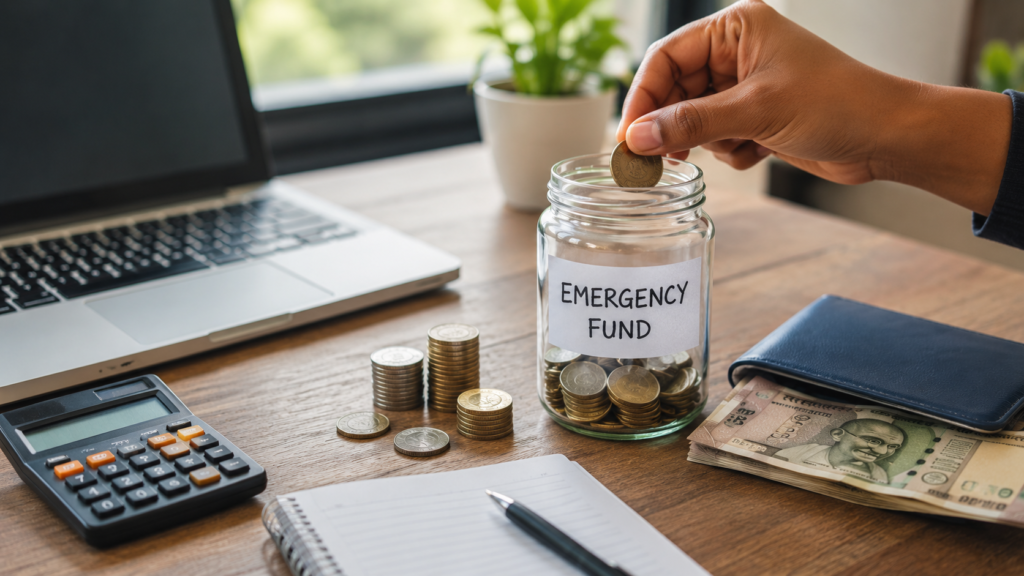
Most financial guidance suggests keeping 3 to 6 months of essential expenses in an emergency fund, with 6–12 months often recommended for freelancers, single-income households, or those with dependents. The right amount depends on job stability, existing insurance coverage, number of dependents, and monthly fixed obligations like EMIs — so treat these ranges as a starting point to adjust, not a fixed rule.
Introduction
An emergency fund is often the difference between a temporary setback and a long-term financial crisis. A medical emergency, sudden job loss, or urgent home repair can derail years of financial planning if there’s no buffer to absorb the shock.
In this guide, you’ll learn what an emergency fund actually is, how to calculate the right amount for your situation, where to keep it so it stays accessible without losing value to inflation, and the mistakes that commonly undermine emergency savings. This is relevant whether you’re salaried with a stable income, a freelancer with variable cash flow, or someone starting from zero.
What Is an Emergency Fund?
An emergency fund is money set aside specifically to cover unexpected expenses — such as a medical emergency, sudden job loss, urgent vehicle or home repair, or a family crisis — without relying on high-interest debt or disrupting long-term investments.
It’s distinct from regular savings or investments in one key way: an emergency fund’s purpose is accessibility and stability, not growth. It should be liquid (quickly withdrawable) and low-risk, even if that means lower returns than other investments.
How Does an Emergency Fund Work?
An emergency fund works as a dedicated, separate pool of money that sits untouched until a genuine emergency arises. The process generally looks like this:
- Calculate your essential monthly expenses — rent/EMI, groceries, utilities, insurance premiums, minimum debt payments, and other non-negotiable costs.
- Decide on a target multiple — typically 3 to 6 months of essential expenses, adjusted for your personal risk factors.
- Choose where to hold it — usually a high-interest savings account, a sweep-in fixed deposit, or a liquid mutual fund, prioritizing accessibility over returns.
- Build it gradually — through consistent monthly contributions rather than waiting to save it all at once.
- Replenish after use — if the fund is used for a genuine emergency, treat rebuilding it as a priority in the following months.
Why Does an Emergency Fund Matter?
Without an emergency fund, unexpected expenses are typically covered by credit cards, personal loans, or borrowing from family — options that can carry high interest costs or strain relationships. An emergency fund breaks that cycle by giving you a self-funded buffer.
It also protects long-term investments. Without accessible cash, a financial emergency can force early withdrawal from retirement accounts, mutual funds, or fixed deposits — sometimes at a loss, or with tax and penalty implications. Emergency funds are also a psychological safety net: the FAQ research consistently shows this reduces financial anxiety and supports better day-to-day decision-making, since there’s no fear that everyday setbacks will spiral into a crisis.
How Much Should You Actually Save?
There’s no single number that fits everyone. The right target depends on several personal factors:
| Factor | How It Affects Your Target | Why It Matters |
|---|---|---|
| Job stability | Stable government/PSU job → closer to 3 months; commission-based or startup income → 6–12 months | Job loss risk directly affects how long you may need the buffer to last |
| Number of dependents | More dependents (children, aging parents) → higher target | More people relying on your income increases the cost of a income disruption |
| Existing insurance coverage | Adequate health insurance → can lean toward the lower end of the range | Health insurance absorbs a large share of medical emergency costs, reducing pressure on the cash buffer |
| Income type | Salaried with regular income → lower end; freelance/business income → higher end | Irregular income means income disruptions are harder to predict and can last longer |
| Existing debt (EMIs) | Higher fixed EMI obligations → higher target | EMIs continue regardless of income disruption, so the fund needs to cover them |
A commonly used starting formula: Essential monthly expenses × 6 = Base emergency fund target. Adjust upward if you fall into higher-risk categories above, or downward (though rarely below 3 months) if your income and dependents suggest lower risk.
Example: Calculating an Emergency Fund Target
Assumptions: This example is illustrative and uses a hypothetical salaried individual in a metro city with one dependent and a stable job. Actual figures will vary by city, family size, and personal circumstances.
| Essential Expense | Monthly Amount (₹) |
|---|---|
| Rent | 15,000 |
| Groceries & utilities | 8,000 |
| Insurance premiums (monthly equivalent) | 2,000 |
| Loan EMI | 10,000 |
| Transport | 3,000 |
| Total Essential Expenses | 38,000 |
At a 6-month target: ₹38,000 × 6 = ₹2,28,000 At a 3-month target (more conservative buffer, higher-stability job): ₹38,000 × 3 = ₹1,14,000
Note that this calculation intentionally excludes discretionary spending (dining out, entertainment, shopping) — the goal is to cover essential survival expenses during a disruption, not maintain the full lifestyle.
Where to Keep Your Emergency Fund
The right place prioritizes liquidity and safety over returns. Common options used in India include:
| Option | Liquidity | Typical Use Case |
|---|---|---|
| High-interest savings account | Immediate | First portion of the fund, for instant access |
| Sweep-in fixed deposit | 1–2 days | Portion that earns slightly more but is still quickly accessible |
| Liquid mutual funds | 1–3 days (with instant redemption facility on some) | Larger portion of the fund seeking marginally better returns than a savings account |
Avoid keeping emergency funds in equity mutual funds, stocks, or long-lock-in instruments like PPF — these carry market risk or withdrawal restrictions that defeat the purpose of an emergency fund. Compare current interest rates and redemption terms directly with your bank or fund provider before choosing, since these change over time.
Benefits of Having an Emergency Fund
- Avoids reliance on high-interest credit cards or personal loans during a crisis
- Protects long-term investments from forced, poorly-timed withdrawals
- Reduces financial stress and supports clearer decision-making during a crisis
- Provides a buffer during career transitions, giving more room to find the right next opportunity rather than the first available one
- Covers gaps between when an insurance claim is filed and when it’s actually paid out
Risks, Limitations and Things to Consider
- An emergency fund is not a substitute for insurance. Health and term insurance are typically more cost-effective for large medical or life-risk exposures; the emergency fund is meant to cover smaller, more immediate gaps.
- Holding too much in an emergency fund has an opportunity cost. Money sitting in low-return instruments beyond your actual target may otherwise be growing in long-term investments — the goal is right-sizing, not maximizing the fund indefinitely.
- Inflation reduces the real value of a static fund over time. Revisit and increase your target periodically as expenses rise.
- What counts as an “emergency” needs to be defined in advance. Without a clear personal definition, it becomes easy to dip into the fund for non-emergencies like sales or planned upgrades.
Common Mistakes to Avoid
- Calculating the target based on total income rather than essential expenses
- Keeping the entire fund in a single instrument with poor liquidity
- Treating the emergency fund as a general savings account for non-emergencies
- Waiting to have insurance or investments “sorted” before starting an emergency fund
- Not replenishing the fund after it’s used for a genuine emergency
- Setting an unrealistic target that feels unattainable and leads to abandoning the goal altogether
How to Get Started
- Calculate your essential monthly expenses using the last 3 months of bank statements
- Decide your target multiple (3–6 months as a starting range) based on job stability, dependents, and insurance coverage
- Open or identify a separate account specifically for this fund, distinct from regular spending or investment accounts
- Automate a fixed monthly transfer, even if small, right after income is received
- Choose a liquid, low-risk instrument (savings account, sweep-in FD, or liquid fund)
- Set a realistic timeline (e.g., 12–18 months to reach the full target) rather than expecting to fund it in one go
- Review and adjust the target annually or after major life changes (marriage, new dependent, job change)
Frequently Asked Questions
1. How many months of expenses should an emergency fund cover? Most guidance suggests 3 to 6 months of essential expenses as a baseline, with freelancers, single-income households, or those with significant dependents often considering 6–12 months. The right number depends on individual job stability and financial obligations.
2. Should I build an emergency fund before investing? Many financial planners suggest building at least a small starter emergency fund (around one month of essential expenses) before aggressively investing, since this reduces the risk of having to withdraw investments early during a disruption. After that, many people build the rest of the emergency fund alongside continued investing, rather than fully sequencing one before the other — the right balance depends on your risk tolerance and obligations.
3. Where should I keep my emergency fund in India? Common options include high-interest savings accounts, sweep-in fixed deposits, and liquid mutual funds, chosen primarily for liquidity and safety rather than high returns. Comparing current rates and redemption timelines with your bank or fund provider before deciding is worth doing, since these details change.
4. Is a credit card limit a substitute for an emergency fund? A credit card can provide short-term liquidity in a genuine emergency, but it isn’t generally considered a substitute for a cash emergency fund, since it carries high interest costs if not repaid quickly and depends on continued creditworthiness and approved limits. It can serve as a secondary backup, not a primary plan.
5. How do I build an emergency fund with irregular income? Basing the target on essential expenses (rather than income) and contributing a percentage of each payment received, rather than a fixed monthly amount, is a commonly used approach for freelance or commission-based income. This adapts to income variability while still making consistent progress.
6. Should my emergency fund cover discretionary expenses too? Most guidance recommends calculating the fund based on essential expenses only — rent/EMI, groceries, utilities, insurance, and minimum debt payments — rather than full lifestyle spending, since the goal is to cover survival needs during a disruption, not maintain regular discretionary spending.
7. What counts as a genuine financial emergency? Common examples include job loss, a medical emergency not fully covered by insurance, urgent essential repairs (such as to a home or primary vehicle), or unavoidable family emergencies. Defining this clearly in advance helps prevent the fund from being used for non-emergencies like planned purchases or sales.
8. How often should I revisit my emergency fund target? An annual review is generally reasonable, along with a review after major life changes such as a new dependent, a job change, a significant increase in EMI obligations, or relocation to a higher cost-of-living city.
Conclusion
An emergency fund isn’t about picking a number and forgetting about it — it’s about matching your buffer to your actual risk factors: job stability, dependents, insurance coverage, and fixed obligations. Start with the 3–6 month range as a baseline, calculate it against essential expenses only, and build it gradually through automated monthly contributions in a liquid, low-risk account. As a practical next step, calculate your essential monthly expenses this week using your last three bank statements — that single number is the foundation for the entire emergency fund plan.